Showing posts with label children. Show all posts

Thursday, February 27, 2014

Storytelling with Props


Verbal Storytelling with Props 
A few ideas to get you started
 By Cheryl Jackson 
of
Children love stories – whether reading books, listening to story CD’s or having stories told to them. We as parents and caregivers know that stories feed the imagination of children and provide strong foundations for children’s own storytelling, as well as rich and varied language development and a love of books. Sharing stories is also great fun!
 A different approach to stories is making up your own whilst incorporating characters and props in scenes for your children to watch. This can be really personalized for the children and you can pitch the story just right for their attention spans, ages and interests. However it can be a bit of a scary prospect for a novice storyteller! So here are a few ideas to get you started.
https://www.etsy.com/listing/164419528/needle-felted-stone-gnome-in-his-home?ref=shop_home_active_1
Step 1:  Setting the Scene
As you'll see in the photos below, your story can take place anywhere. There should be a defined stage for the story to be enacted upon and a comfy seating area for the audience to sit. In the stories above I have used my dining table while the children sat on the chairs, the sofa and low table with the seating area being cushions on the floor, outdoors on the patio with waterproof fabric to sit on and my seasonal table shelf with beanbag seating. It is enough to suggest the scenery with appropriate colored fabric pieces, natural materials and simple shelters made from folds of fabric, piles of stones, boxes, building bricks etc. The children have great fun guessing what the story will be about as they watch you set the scene.
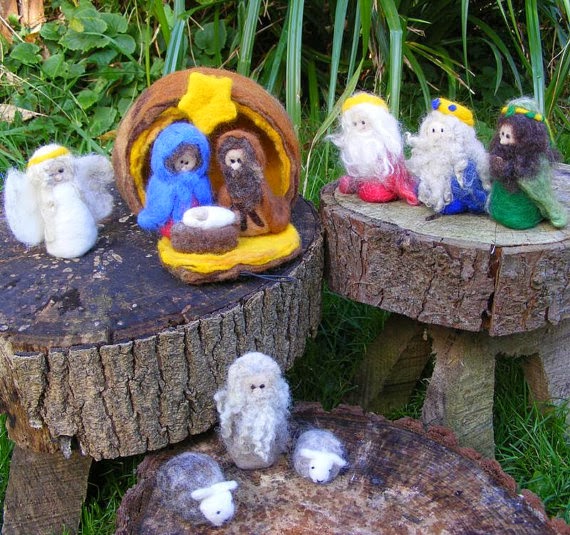
To populate your stories you can raid bits from the children’s toy boxes or have a special set of figures, animals, etc. that are kept just for telling stories with. You can hand make your own characters and scenic objects – in the stories below I have used felt dolls, needle felted animals and folk, and clay models. Whilst the children model clay or thread felt necklaces, they like to watch me make new props and people for the story basket.
Step 2:  Telling the Story - Seven Story Ideas to Get You Started:
A Winter’s Tale 
Grandma and Grandpa’s day in the snow, caring for the hungry animals, fetching firewood and making tea.
https://www.etsy.com/shop/softnwoolly
How about a story about a family’s daily activities involving the seasons, festivals and your children’s own daily activities. The family characters can reflect your own family make up and include pets and friends. This type of story can be told daily or weekly and awaken children’s awareness of the cycle of the year and the rhythm of their home life.

At the Construction Site 
A handbrake left off and the empty car rolls over the cliff, how the diggers and trucks work together to move the car and take it to be repaired.
Children who enjoy playing with their favorite small world toys love to see them starring in a story. Seeing new possibilities for ways of using these toys helps children to develop their own narrative threads and enriches their play.  Other vehicles, animals, dolls, houses, soft toys, pirates, knights etc. can be used.
The Spider’s Web
How the spider tried to trap the bee in his web and how the other insects saved the bee.
                             
A story can be educational, building on a child’s interests and adding new factual knowledge in a fun way. This type of story can broaden and support topics being learnt at school, perhaps awakening enthusiasm for a subject they find difficult or tedious. Think water cycle, homes and shelters, counting, mini beasts – take time to make sure you understand the subject and have your facts right before you start!


The Lamb Who Never Listened
Naughty lamb never listened to his parents and kept getting into trouble, rescued by the farmer, owl & fawn.
Sometimes children have difficulty in learning acceptable behavior, often in relation to others. Stories that reflect the problems they are experiencing and show how the story characters resolve these difficulties can help a child recognize a new way forward. As well as situations such as sharing and helping others which can positively affect all children, the story can cover a specific issue such as fear of thunder or death of a pet.  Using a gentle, supportive approach helps children who may not want to talk directly about their worries.

Jack Frost and The Snowdrop Girls
How Jack Frost covered the garden in glittering snow and how the Snowdrops Girls swept him away to make Spring arrive.
                           
Fairies, pixies, gnomes, elves, mermaids, witches, wizards – introduce your children to the magical folk that live in your home and garden, maybe only ever seen by children. . . Fantasy worlds populated with dragons and unicorns, full of spells, quests and treasure – add glitter and magic to your children’s imaginations!
Little Red Riding Hood
All the animals warn her about the wolf, the wolf shuts grandma in the outside loo and pretends to be her by dressing in her hat and apron, wolf tries to catch red riding hood, the animals tell the woodcutter, the wood cutter rescues red riding hood and chases the wolf away
                   
A good place to start is retelling a traditional fairy tale. You can use the farm animals, soft toys, dolls etc to retell a story the children know well. Put your own twist on it such as changing the Three Billy Goats Gruff to being about a sheep, a cow and a horse if you don’t have three different sized goat figures. Or maybe the three bears don’t eat porridge but muesli, toast and yoghurt? In your story, Cinderella could have two grumpy brothers and go to the ball in a limo. Allow your children to see other ways to tell a story and that it is good fun to embellish and enlarge on a basic theme.

Step 3: Letting The Children Join In
After the story is finished and you have said ‘The End’, it's the children’s turn. How you do this depends on your children’s age and development, but these are the steps I use as the children grow.
1.  Retell the story and let the children move the characters around the scene.
2.  The children retell the story as they move the characters. At first they just retell key phrases and the bits of the story that interested them the most or the ending which is freshest in their mind, but soon they will remember more of it.
3.  The children will begin to add on their own bits to your story or take the characters in a different direction – it can help if you provide extra props and characters next to the scene so they have fresh ideas to hand.
4.  Don’t forget to role model good audience behavior! Sit still and watch, listen carefully, clap and say thank you at the end of the story. Enjoy your children’s storytelling and discover the events and activities in your lives together that they recall and incorporate into their tales. This can be very surprising!
So gather round, sit yourselves down comfortably and enjoy the story. . .
Special thanks to Cheryl of Waldorf on Etsy shop SoftnWoolly for her wonderful article on storytelling!


Monday, October 14, 2013

100 Ways To Be Kind To Your Child

In honor of my sons, my nephews, my cousins and all the other October birthdays, here is a post to inspire you to bring more kindness to your everyday life.  I'm stepping outside the Waldorf on Etsy team today to bring you the work of  Alissa, a homeschooling mom to three kids, who blogs about having a fulfilling, creative life that includes her children:  
100 Ways to be Kind to Your Child was written in February 2012 by Alissa, as a participating blogger for Toddler Approved’s 100 Acts of Kindness Challenge.  She spent a month knowing she would be writing about how to be kind to her children.  It’s not that she didn’t want to be kind to her kids all the time, but, it made a real difference to be thinking about this list.
"When I consciously decided to find ways to be kind to my kids I found I was catching myself more often before I sighed impatiently." Alissa shared,  "I started finding more times to make kind eye contact, or smile.  These are just little shifts, but they add up. "
Needle Felted Madonna and Child
Here is a sampling of ideas from the list: 
Tell your child:
2. I love you no matter what.
5. I love you when you are far way.  My love for you can reach you wherever you are.
8. Thank you.
9. I enjoyed playing with you today.
10. My favorite part of the day was when I was with you and we _______.
Share:
11. The story of their birth or adoption.
14. A story about yourself when you were their age.
16. What your favorite color is.
17. That sometimes you struggle too.
18. That when you’re holding hands and you give three squeezes, it’s a secret code that means, “I love you”.
Play:
22. Hop Scotch
23. Board Games
26. Twenty Questions
27. I Spy on long car rides
28. Catch
Pretend:
29. To catch their kiss and put it on your cheek.
30. That their tickle tank is empty and you have to fill it.
31. That their high five is so powerful it nearly knocks you over.
33. That you are explorers in the amazing world of your own backyard.
Try:
35. To get enough sleep.
37. To eat decent food.
38. Dressing in a way that makes you feel confident and comfortable.
41. Dancing in the kitchen.
45. Using a kind voice, even if you have to fake it.
Read:
46. A book of silly poems.
47. A story and then act out the plot.
48. Your favorite childhood book to them.
50. Outside under a tree.
53. About age appropriate behavior so you can keep your expectations realistic.
Listen:
54. To your child in the car.
57. One second longer than you think you have patience for.
58. For the feelings behind your child’s words.

Ask:
60. What do you think would happen if______?
61. How shall we find out?
62. What are you thinking about?
Show:
65. Your child how to do something instead of banning them from it.
68. How to cut food.
69. How to fold laundry.
70. How to look up information when you don’t know the answer.
72. That taking care of yourself is important.
Take Time: 
74. To look at the birds.
75. To let your child pour ingredients into the bowl.
76. To walk places together.
77. To dig in the dirt together.
78. To do a task at your child’s pace.
Trust:
80. That your child is capable.
81. That you are the right parent for your child.
82. That you are enough.
Delight:
84. Clean your child’s room as a surprise.
86. Put a love note in their lunch.
87. Make their snack into a smiley face shape.
89. Sit on the floor with them to play.
Let Go:
91. Of how you thought it was going to be.
92. Of your need to be right.
Give:
93. A kind look.
94. A smile when your child walks into the room.
97. Your child a chance to work out their frustrations before helping them.
99. A hug.
100. You get to choose the next one!  What is your favorite way to be kind to your child?
To read the full list, to learn more about Alissa and to connect with her, visit her Etsy shop:
And sign up for her Joyful Parenting newsletter to get more simple ideas about how to nurture connection with kids.  

A big thank you to Alissa for sharing her ideas on kindness with us!
Enjoy!

Sunday, May 5, 2013

Learning About Eurythmy

A World on Movement & Expression
 Eurythmy was introduced into the curriculum of the first Waldorf school by Rudolf Steiner in 1919.  It is a discipline of original artistic movement that strives to make language and music visible. 
   
Needle Felted Angel
"If a human being reveals through eurythmy-gestures what his being inherently possesses as language, and enables the entire soul experience to become visible, then the mysteries of the world may be artistically expressed."
-- Rudolf Steiner
 
Rainbow Play Silk
  The aim of eurythmy is to speak and sing through movements and gestures that reveal to the eye what language and music bring to the ear. The movements of the eurythmist reveal inner soul experiences and relate them to the surrounding space. These movements can vary from simple hand gestures to those involving the whole body.  
 
 Compositions of pure eurythmy can be performed with or without accompaniment by language or music. Those performed without accompaniment are often profoundly meaningful for audiences and can be an essential contribution to the repertoire.
Rainbow Play Silk
No matter what age the individual, everyone can benefit from doing eurythmy.  The lessons begin in kindergarten and develop right up to the twelfth class in tune with the maturing growth of the pupils. “Art does not reproduce the visible; rather, it makes visible.” - Paul Klee
 
Needle Felted Sun Goddess 
A special thanks to the Discover Eurythmy website for the information and quotes in this blog post.  For more information and to explore on your own please visit their website.


Sunday, February 10, 2013

The Nine Year Old Child

The purpose of today's blog post is to acknowledge the special needs of the nine year old child and to celebrate their unique perspective.  My middle child recently turned ten, but last winter, early in his ninth year I was given a copy of an article that helped me understand some of the changes he was undergoing.  Not only did it help me understand his situation better but helped to remind me what a special gift it is to have a child transitioning into a new phase of life.  Following is  the orginal article as it was posted at www.waldorfinthehome.org
Parenting the Nine Year Old
by Rahima Baldwin Dancy
Parents of nine year olds often wonder, "What is happening to my child?" Children at this age can become very critical and argumentative, or very moody and withdrawn. Nightmares, irrational fears, headaches and stomachaches often arise. Some children feel as if no one at school likes them, or others become suddenly self-conscious about being rich, poor, or otherwise "different." Parents may be accused of being unfair or of not understanding, as the child rushes off and slams his or her door.
Searching for an explanation for the changes in behavior, parents sometimes blame a new teacher, a recent move, changes in the family such as separation or the birth of a sibling, or simply "growing pains". An understanding of what is actually taking place can help us avoid needless worry and provide the support and guidance that children need during this time.
What is Happening?
The special needs of the nine year old are the result of an important change in consciousness that marks the end of early childhood and the transition to a new developmental phase. Rudolf Steiner, the founder of Waldorf education, states, "In the ninth year the child really experiences a complete transformation of its being, which indicates an important transformation of its soul-life and its bodily-physical experiences."
Earlier, before the age of five or so, the child has a dreamlike state of consciousness in which the outer world and inner experience end to flow together. Outer events are not "observed," but are deeply taken in through unconscious imitation. Whereas babies learn nearly everything through imitation, kindergarten-age children continue to imitate many aspects of their world, such as the movements of the teacher or parent.
While the power of imitation is so strong, the child feels united with the world and experiences no sense of aloneness. But with the loss of this power around the age of nine, the child feels separated from the world. Something that was hidden and slumbering begins to awaken. Nine year olds suddenly have a strong experience of themselves as separate beings, with a new feeling of distance from the world and other people. This sense of self, first experienced around age two-and-a-half, recurs now in a much deeper way, as the inner emotional life of the child begins to develop.
Although children react differently to leaving the sweet, dreamlike world of early childhood, one response is nearly universal: children become more conscious of their surroundings. You will probably find that what was once passed by unnoticed is suddenly focused on and questioned. This awakening to the world may be met with quiet astonishment or sharp criticism, depending on the child's temperament.
A critical child may notice whether the statements people make are grounded in the real world or are a veneer. He or she may begin to question parents and teachers, wondering, "How do they know everything?" and, indeed, "Do they really know everything?" Something in the child is seeking reassurance that the authority of the adult will stand the test of quality, and that it carries an inner certainty.
In contrast, another child may become more withdrawn and start to look under the bed at night, or may have frequent stomachaches in response to this new sense of being alone. Parents whose children suddenly want to be alone often feel as if they are "losing" their children, as if the children no longer want to share their developing inner worlds. This is a time when intimations of mortality and death can enter a child's consciousness. Religious questions and concerns about good and evil may also emerge with the child's increased self-awareness and sense of choice and responsibility.
Usually, within six months after the ninth birthday (and sometimes earlier), the children are profoundly aware of this new sense of separateness between the self and the outer world. As the "I" penetrates into awareness, children begin to experience themselves as self-contained beings. The often feel as though they are in a threshold situation, poised, as it were, on the cusp of their own destiny. A 70-year-old woman wrote of this time in her life: "In this year I had a significant I-experience. I had just come from school in the city and had to change trams. In this moment of waiting, the complete certainty came to me that now all of life lay before me and that I was the one that must travel it.
Essentially, the nine year old is experiencing his or her own identity-to become a separate individuality, able to confront the outer world. Ideally, the child comes through this difficult time with a sense of connection with his or her higher self, a kind of "knowing" that will remain even after the heightened awareness is integrated.
My son spent many difficult months in the throes of "the nine-year change." One night, as he popped out of bed for the third time, I had to muster great self-control to say, "What now?" "I'm glad I'm me!" he announced, radiating like the sun. He went on to explain, "It's just like the song "The Age of Not Believing." The words of the Disney song ran through my mind: "You must face the age of not believing, doubting everything you ever knew. Until at last you start believing, there's something wonderful in you." We all shared in his joy and thanked God that family life could once again return to normal.
Parenting Tips
What can parents do to help their child through this important turning point at age nine?
- Understanding what is happening will help both your child and yourself as a parent. When both parents, or parents together with the teacher, consider a child and his real needs, it can help give the child balance. Be patient-- this, too, shall pass. Ten is a wonderfully harmonious time between the crisis at age nine and adolescence, when the next intensifying of self-consciousness occurs.
- Be willing to let your child have her own inner emotional life. You can't "fix it." Honor her need for privacy or her sudden impatience with a younger sister. Be willing to let go and tolerate distance. Your relationship is changing and will improve again once alterations have been completed. Be nearby with understanding and reassurance that she is still loved.
- Share your thoughts with your child about things that go beyond the every-day affairs of life. But don't limit your child by providing "answers" or definitions that can't grow within the child when asked about things like God or death.
- Have faith in self-healing, in your child's ability to come through this phase. Support individual artistic activity that attracts your child (writing poetry, keeping a diary, drawing or painting, music).
- Support your child's interest in the world by providing opportunities to build things, visit a farm, plant a garden, do work in the real world. Encourage a connection with the plant and animal kingdoms and with simple human creative activities now before the child explores the world of technology, which is more appropriate for adolescence.
- Nourish your child with stories that illustrate the interconnectedness of life and the powers of fate and destiny. The story of Joseph and his coat of many colors has this element of the dream heralding his destiny and the patience he needed to see it manifest. In the curriculum of the Waldorf schools, the Old Testament stories are .told in third grade because they mirror 2- the inner state of the nine-year-old child. The creation story, for example, describes the child's own experience of leaving the paradisiacal realm of early childhood, acquiring new self-awareness, and with it the added dimensions of choice and increasing responsibility for one's actions. In fourth grade the heroic tales of the Norse myths represent the exploits of the new ego in larger- than-life fashion. The Waldorf curriculum also introduces the child to the world through projects in house-building, farming, and the study of the plant and animal kingdoms, not as abstract sciences, but in relation to the human being.
- Recognize that the child needs to establish a new respect for adult authority that goes beyond the blind acceptance of the younger child. Parents can encourage this by honoring a child's new relationship with a teacher or other adults in his life. Steiner states, "What matters is that at this moment in life, the child can find someone--whether this be one person or possibly several persons is of less importance--whose picture it can carry through life."(3) Parents can also help themselves be this kind of authority by presenting a united front to the child and by both sitting down with the child when questions of discipline arise (single parents may want to bring in a teacher or other adult during this time).
The magnitude of the changes that a child of this age is going through can be better understood if you contemplate the differences between the child of seven and the child of twelve. The seven year old is light-hearted and always in movement. The limbs are active for learning (through touching, doing, walking the times tables, and so forth). In contrast, the head is relatively large and still dreamy. The seven year old is just beginning to get adult teeth. His or her emotions are easily influenced by impressions from the world, with tears changing to smiles relatively easily.
The twelve year old, on the other hand, has a head that is very awake for thinking and longer limbs which seem heavy, tired, and often awkward to control. There is a rich and sometimes over-powering inner emotional life; the older child brings a great deal more to each experience. Physically, the sexual organs are beginning to mature as the child enters puberty.
The nine-year-old is in the middle between the world of early childhood and the world of adolescence. The physical and emotional changes which you may observe in your nine-year-old child are the outer manifestations of the tremendous change in consciousness which is going on within the child's expanding inner world. By understanding the nature of these changes, we can better provide support in parenting the nine year old.
Awakening to the world and a new sense of self brings with it a new need: to understand the real world of everyday life, while at the same time long for intimations of something beyond ordinary life. As parents and teachers, our task is to become loving authorities for the growing child, sharing both a true picture of the world and a sense of our own inner striving.
Notes
1. Quoted in Hermann Koepke, Das neunte Lebensjahr (Dornach, Switzerland: Philosophisch-Anthroposophischer Verlag, 1983), p. 41.
2. Ibid., pp. 32-33.
3. Rudolf Steiner, Soul Economy and Waldorf Education (Spring Valley, NY: Anthroposophic Press, 1986), p. 167.
For More Information
Branston, Brian. Gods & Heroes from Viking Mythology. New York: Schocken,1982.
Colum, Padraic. The Children of Odin: The Book of Northern Myths. New York: Macmillan, 1984.
Crossley-Holland, Kevin. The Norse Myths. New York: Pantheon, 1981.
de Paola, Tomie. Parables of Jesus. New York: Holiday House, 1987.
Horn, Geoffrey, and Arthur Cavanaugh. Bible Stories for Children. New York: Macmillan, 1980.
Stoddard, Sandol. The Doubleday Illustrated Children's Bible. New York: Doubleday & Company, 1983.
Wilkinson, Roy. Old Testament Stories and Commentary on the Old Testament Stories. Available from Rudolf Steiner College Bookstore.
[This article is copyright 2012 by Rahima Baldwin Dancy and may be reproduced in full as a handout if reference is given to www.waldorfinthehome.org]

Wednesday, February 6, 2013

Soft n Woolly


  Today we welcome the Waldorf on Etsy artist and shop owner of:
My name is Cheryl, I am a wife, mother, childminder and needle felter! My love for children, nature, fantasy and crafting has all come together in my shop on Etsy – Soft n Woolly.
For many years I have tried out different crafts such as tapestry, sewing, knitting (not very good – almost drove my Nan mad trying to teach me!), macramé and card making amongst others. I never, though, found the special one that had me hooked. That all changed when I attended a course run by a Steiner Waldorf Kindergarten teacher and learned many wonderful things – one of them being needle felting.
I bought some needles, wool and foam of my own and began to experiment, using a few books for advice. I made friends at the Waldorf School Parent and Child group and we began to meet up and craft together when the children were in bed. We still do this and I still love it! After a busy week it is lovely to get together with friends, have a pot of tea, cut a cake, catch up on news and create little folks from fluffy wool and sparkly bits.
My Etsy shop was opened up when my love of needle felting began to outstrip the number of birthday gifts I had to give! I sold some of my creations at my local Waldorf School’s Advent Fair and lots of people seemed happy to purchase them. This made me wonder if there were more people out there who would love to own one of my warm and fluffy creations and so I opened Soft n Woolly.
I sold some of my creations at my local Waldorf School’s Advent Fair and lots of people seemed happy to purchase them. This made me wonder if there were more people out there who would love to own one of my warm and fluffy creations and so I opened Soft n Woolly. On Etsy I have found a wonderful team of fellow artists, advice and companionship as well as an effective outlet for my woolly art.
Needle Felted Tree
Needle felting has a magic that is very special to me. I love the gorgeous colours and textures of wool and other fibres, the endless potential embellishments of beads, threads and materials and the joyous feeling as my final creation in all its woolly glory is born.
Each and every one of my animals, fairies, people and homes I make is a part of myself, from the original design idea, choice of colour and materials, the felting itself and the little story about it that arrives in my head as I work.
Green Witch with Her Broom
All my creations have a very special character all of their own and are distinctive as mine. I send them out into the world to bring joy to their new owners and to be loved and cherished by them.
 Tree of Love
Visit Soft n Woolly to see more of Cheryl's wonderful creations!

Monday, February 4, 2013

Nature Tables

A nature table is a special way to bring a little bit of the beauty and magic of Nature into your home.  Creating and maintaining the nature table to represent the changing seasons is a wonderful activity for adults and children to share together.  Nature tables can be very simple or elaborately detailed depending on how they harmoniously fit into your home life.
  The first step to creating your nature table is to find a good location in your home.  You can dedicate a small table for this purpose, or you can use part of the space of a larger table, window sill, bookshelf, etc.  It helps for the nature table to be easy to reach for the little ones in the house. 
While out on a nature walk you can collect things to add to your nature table.  Things you  make together to reflect the current season or handmade items you purchase to celebrate nature are also great additions to your nature table.  Very likely you already have some special pieces you've collected over the years that can find renewed treasuring through display on your Nature Table.
 A beautiful rock, an interestingly curved stick, an abandoned birds nest, some moss, or any other item that seems right to you and your child.  A needle felted fairy, a family of wooden peg gnomes, or a seasonal angel resting amongst your natural treasures encourage children to dream and play.
The key to the nature table is that it's accessible to the children in your home.  Encourage your kids to play at the nature table, to move around the items, to play with the fairies and gnomes, to touch the rocks and leaves.   Let them add things they find to the nature table and change it to reflect the seasons changing outside your windows.
Don't feel constrained to keep your nature table on the table - pictured above is a beautiful example of bringing nature into your home in a unique way!  This kind of garland could hang above your nature table, or be a way to bring some of nature into your child's bedroom.  Remember it's your nature table - be creative and follow your heart in creating it!
  Let your imagination soar as you arrange the items on your nature table and enjoy the changing seasons! 
For more creative ideas to decorate your nature table, browse the Waldorf on Etsy team shops - you're sure to find something lovingly crafted by hand to enhance your own nature table.

Saturday, February 2, 2013

Claudia Marie - Needle Felted Creatures and Fantasy

Today we welcome Claudia Marie, Needle Felt Artist and Captain of our Waldorf on Etsy Team!
If not for my journey into Waldorf education, I likely would have never became a fiber artist.  That journey began when I was assigned to write a story about Waldorf education for a Chicago-area magazine, Conscious Choice.  My son, Johnny, was an infant at the time.  As I researched Waldorf education, I was awed.  This was the education that I wished I had; this was the education I wanted for my son.  When Johnny turned 4, we found a Waldorf school; he is now in eighth grade at DaVinci Waldorf School in Wauconda, IL.

As a Waldorf mom, I reconnected with my artistic side. My mother had taught me all the handwork arts as a child, so it didn’t take long for me to remember how to knit and crochet. 
I so loved making toys for Johnny. Taking bendy figures and sewing little clothes that turned them into knights, princesses, and cowboys. I also created fingerpuppets in a free-form crochet style. I crocheted little kittens, unicorns and bunnies out of soft yarn like alpaca and cashmere.
That was when I first yearned to make animals out of wool. However, it was years later until I finally realized that needle felting was the perfect medium for what I wanted to create. I was very inspired by some of the wonderful artists on Etsy.
I make needle felted animals, fairies and angels. I love working with wool and other natural fibers. I feel like these contributions from beautiful animals adds spirit to my creation. 
Many of my animals and all of my dolls are poseable. I love to use very soft fibers on my animals—especially alpaca. Some of my animals are coated in luxury fibers, like cashmere, baby camel and angora. I pay a lot of attention to detail and my animals take a long time to create. 
 My dolls are also quite luxurious. I usually use merino wool in their dresses and often accent with silk on their dresses or in their hair. I love styling their hair!
Most of my items are better for room décor or storytelling, than for vigorous play.
I love being part of the Waldorf on Etsy team. We have real camaraderie and we are an international team. It is interesting to get to know Waldorf-inspired artists from around the world.