Showing posts with label childhood education. Show all posts

Monday, January 27, 2014

The Importance of Nature to Children

Connecting the Seasons in Waldorf Education 
by Claudia Marie Lenart
In Waldorf education, we celebrate the changing seasons in the classroom, in the community with seasonal festivals, and in the home.  Waldorf classrooms always include a beautiful season’s table that is decorated with gifts of nature, handmade animals, and items that reflect the present season.  Inspired by the beauty of the classroom, Waldorf parents often find a space in their homes as well for a seasonal nature table. 
The awareness of the seasons and celebration of seasonal festivals has meaning in the Waldorf curriculum.
Recognition of the seasons establishes rhythm for the child and the natural rhythm of life is central to Waldorf philosophy.  Rahima Baldwin Dancy, author of You are Your Childs’ First Teacher, says that rhythmic activities provide children with a sense of security. 
“The slower rhythm of the natural world with its changing seasons can provide the “content” of our experiences, as well as a powerful healing influence,” according to Waldorf Early Childhood Association of North America.
Autumn Family by Soft Earth Art
Awareness of the changing seasons allows children to better appreciate nature and to feel at home in the natural world.  For Waldorf children, daily outdoor play is essential, through the heat of summer and even on the most frigid winter days.  Of course, Waldorf parents send their children to school with boots, hats, scarves, wool mittens –well prepared for the weather.  If the schoolyard has the slightest hill, you will be sure to see the children sledding daily in the snowy months. 
  
Observation of the changing seasons in early childhood provides a foundation for later scientific study.  As the child progresses through Waldorf school, teachers will take hiking trips where students will study and draw the anatomy of a plant or observe weather patterns.  The seasons are a perennial subject for Waldorf watercolor paintings as well. 
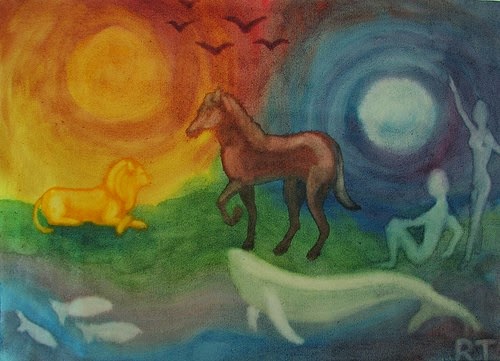
Feeling at home in nature throughout the seasons, provides a child with a sense of wholeness and belonging to the world.  This sense of wholeness is at the foundation of Waldorf education and observation of the seasons instills a greater sense of connection to the natural world and to all life. 
Claudia Marie Lenart, Waldorf parent, volunteer, and longtime writer about Waldorf education is a needlefelt artist on Etsy.  Her shop is ClaudiaMarie Felt.

Thursday, August 8, 2013

Waldorf Toys that Promote Learning, Naturally

Open-ended play is a most important part of learning in the Waldorf kindergarten.
Waldorf Playsilk Children can turn a blue silk into a river, a green silk into a grassy field, a yellow silk becomes a cape.
Natural materials like felted acorns can become food or even currency.
Simple Waldorf dolls allow children to nurture; and felted or wooden animals feed a child’s imagination.
There are also simple, Waldorf toys that can teach children more specific lessons, such as the fire, water, air, earth stacking toys from Simple Gift Toys.
A wooden memory game from Petals and Sunshine can help build cognitive skills. 
Math gnomes from LaLutine make first grade learning so much more fun.
Older children can learn about permaculture with Gaia’s Garden cooperative board game from Living Earth Games.
Visit the Waldorf on Etsy Team shops for more toys and learning games.

Sunday, July 14, 2013

Yelena

Today we welcome Yelena Beskrovni, owner and artist of the Waldorf on Etsy shop, Yelena's Anthroposophical Toys.

About Myself
I studied pedagogy in Ukraine, but in those days I was yet to hear anything about Waldorf.  However, even then I felt that there must be a better method to bring up children than the modern factory-like grade system.  One day I heard about anthroposophy and I was instantly hooked.
 
Later I moved to Israel and brought with me the love for Waldorf education and the desire to help children benefit from its teachings.  I started working in a non-Waldorf kingergarten.  At first the management was skeptical about Waldorf, but when they saw that children were becoming much more open, trusting and caring, they warmed up to anthroposophy and Waldorf ideas. 

How Did I Start Making Toys?
 
I've always wanted to make toys.  I took lessons and discovered just how wonderful the process of making one really is.  I believe that every doll I make has its own soul - the pose it takes while I make it, the way its head is turned, all make it unique. 

What Is Special About My Toys?
I make my dolls only from natural materials.  I use high quality merino wool (and occasionally mohair) and only natural dyes. It's very important to me not to expose the children to any harmful materials or mass-manufactured elements.
In addition to the toys in my shop I also make toys for the kindergarten I work in.  I love to see how the children play with them, use them to enrich their fantasy and learn about the world.  My toys are durable, stable and washable - they must be because every day  I see how the children enjoy chewing and bending the toys when they play.  It gives me great pleasure to know that my toys help children in addition to being fun to play with. 
 Come visit my shop
Thank you, Yelena Beskrovni

Monday, July 1, 2013

Syrendell's LAPHH


 ~Love ~ Abundance ~ Peace ~ Health~

Happiness!

  
Kerelaion eBook
 
Jennifer & Rick Tan are the owners of Syrendell.  Syrendell is the collaboration of love, abundance, peace, health and happiness in the Tan Family.  They share their knowledge and talents with others through their arts, crafts, writing, and music in order to help others have an enriched, holistic, joyful life! 


Syrendell's mission is to provide you with handmade 
toys, crafts, fiber arts, custom aromatherapy and harp music 
so that you may fill your home with opportunities to learn 
and LAPHH!
 Their items are wonderful for home learning, for artists, as well as for Waldorf-inspired folks and families who wish to attain a more holistic, artistic, and natural family life.
 
Wood Crochet Hook Set
 
Follow their blogs and join them on their magical journey:  


You can also "Like" their Facebook page! www.facebook.com/syrendell

 Chalk Drawing Video & eBook
Syrendell are proud members of the Waldorf on Etsy Team!

Tuesday, May 28, 2013

Knitting with Children


Learn to Knit with Your Kids
By Brenda Massei of Pail & Pie
At a local outdoor trades fair my boys and I saw a woman dyeing and drying wool yarn. Her skeins looked like drying pasta on handmade racks and drew us in. Naturally, I started asking her about her yarn and then steered our conversation towards knitting, a favorite pastime of mine. She pointed to my sons, then ages six and four, and said, "How old are they? On the prairie, that one (pointing to my six year old) would be knitting his own socks or he would have cold feet." My son looked at me and I at him in disbelief. Hand knit socks by children? She had my attention.
Beyond having warm toes on the prairie, knitting has many other lifelong benefits. Waldorf schools have children knitting at the first grade level citing benefits such as focus, concentration, left to right progression pre-reading skills, fine motor skill development, delayed gratification, and confidence building. Ruldolph Steiner said children should knit because it was working on their minds. Children must problem solve, pay attention, and form judgments while knitting. He believed that repeat movements created stronger mental connections, linking a child's thinking to his fingertips. Knitting learned as a child can be carried on through adulthood and has been cited as providing health benefits like lowered blood pressure and chasing away depression.  A little while after I was inspired by the yarn dyer, my six year old son learned to knit, to both of our delight. 
Hand Knit Hackey Sack by Girl Power
Simple ways you can get started knitting with your children:
1. Contact your local senior center.
A mother in our homeschool group had this great idea. Knitters love to share knitting and seniors love to see children. She has learned to knit alongside her son at the local seniors center through weekly social knitting.
2. Visit the local yarn shop.
Most local yarn shops have classes, some free, on beginning knitting. It's good business for them to teach you, so take advantage of it.
3. Search your library.
Perhaps you aren't ready to "sign up" for classes, but are interested in learning at home. Search your local library for books and DVDs on knitting. Ask your librarian to order in a specific book or DVD if they don't have it on their shelf, they almost always can.
4. Browse.
Youtube.com has many tutorials on how to knit. It can be helpful to have the ability to pause and repeat. 
 Hand Knit Wool Barn Bag by Pail and Pie
5. Call Your Local Waldorf School.
Chances are very good that someone who works at the Waldorf school knows how to knit. A simple phone call could yield more information or connections, if not lessons.
6. Check out Ravelry.com.
This website is dedicated to bringing "ravelers" together. Click on the "groups" button at the top bar and find local knitters. Contact them through the site for more ideas on knitting.
7.  Ask.
In conversations with the neighbors mention you would like to learn to knit. I always appreciate my friends as amazing resources. At the mere mention of a topic there is usually someone who can chime in. Perhaps the neighbor's mother knits or perhaps she just saw a free class at the library you missed. You never know unless you ask.
Simple ways to share knitting with your children if you already know how to knit.
It may sound silly, but just letting your child see you knit is a good way to introduce them to it. Your enthusiasm for a hobby can become enthusiasm for them. When they ask if they can try, take advantage.
2. When showing your child the knit stitch teach them this rhyme:
In through the front door
Come around the back
Out through the window
And off jumps Jack.
3. Find simple patterns.
Waldorf patterns are amazing for their ability to turn squares into the sweetest little animals. Some books to try are Kids Knitting by Melanie Falick, A First Book of Knitting for Children by Bonnie Gosse and Jill Allerton and Creative Play for Your Toddler: Steiner Waldorf Expertise and Toy Projects for 2-4s by Christopher Cloud.
4. Be Patient.
Knitting can be confusing and challenging. I have a niece desperate to learn but having trouble with it. We just try it sometimes and leave it alone other days.
Hand Knit Woodland Garland by Pail and Pie
5. Try different things.
If you knit, you have different needles and yarn around. My son learned on very large needles with thick yarn. Others have said their children have learned on small needles. Everyone is different. You can experiment and see what your child has the most success with.
6. Guide their hands.
My younger son holds the needles while I knit. He tells me he's knitting with me. I have held, guided, and showed him the process while knitting my projects.
7. Try finger knitting.
If knitting is not working out for you, don't despair. Try finger knitting or crochet. The repetitive motions are beneficial no matter how you stitch it.

Hand Knit Doll by Girl Power
 Let us know how you learned!
Thanks to these sites for their articles on the benefits of knitting: 

"InThis First Grade, Knitting and Stories are the Focus." WBEZ Blog. Linda Lutton. May 31, 2012.  
"Knittingand Crochet Offer Long-term Health Benefits." PRLOG. Editor Caley Walsh. Feb. 9, 2009.
"WhyTeach Knit and Crochet?." Craft Yarn Council.com.

Make Your Own Handmade Knitting Needles ziezo Crafting and Living in Kenya blog

A special thank you to Brenda Massei for this post!
 Please visit her Waldorf on Etsy shop:  of Pail and Pie
as well as visit her blog:  Pioneer Kids

Sunday, May 5, 2013

Learning About Eurythmy

A World on Movement & Expression
 Eurythmy was introduced into the curriculum of the first Waldorf school by Rudolf Steiner in 1919.  It is a discipline of original artistic movement that strives to make language and music visible. 
   
Needle Felted Angel
"If a human being reveals through eurythmy-gestures what his being inherently possesses as language, and enables the entire soul experience to become visible, then the mysteries of the world may be artistically expressed."
-- Rudolf Steiner
 
Rainbow Play Silk
  The aim of eurythmy is to speak and sing through movements and gestures that reveal to the eye what language and music bring to the ear. The movements of the eurythmist reveal inner soul experiences and relate them to the surrounding space. These movements can vary from simple hand gestures to those involving the whole body.  
 
 Compositions of pure eurythmy can be performed with or without accompaniment by language or music. Those performed without accompaniment are often profoundly meaningful for audiences and can be an essential contribution to the repertoire.
Rainbow Play Silk
No matter what age the individual, everyone can benefit from doing eurythmy.  The lessons begin in kindergarten and develop right up to the twelfth class in tune with the maturing growth of the pupils. “Art does not reproduce the visible; rather, it makes visible.” - Paul Klee
 
Needle Felted Sun Goddess 
A special thanks to the Discover Eurythmy website for the information and quotes in this blog post.  For more information and to explore on your own please visit their website.


Wednesday, April 17, 2013

May Day

A Brief History of May Day 
by Brenda Massei of the Waldorf on Etsy shop Pail and Pie


 Waldorf Play Silk
 A wonderful entry into the summer season is May Day, the first day of May. It’s a celebration of the summer days to come and a thankfulness for spring’s renewal. Many groups brought forth the traditions we use today.
 
 In the past, May 1st  was the exact half point of the Druid calendar and so chosen as a date of great celebration. This date also was celebrated by Romans who held a five day event between April 28th and May 3rd for the Goddess Flora which focused on fertility, flowers, the renewal of the circle of life, and drinking. 


Also, during the Middle Ages, every village square held it’s crowning glory, a freshly cut tree, removed of it’s bark and decorated with flowers and ribbons. Great care was taken in selecting the trees and towns were known to be competitive about the sizes of their poles, which then were signs of fertility as well. 
  
 Floral Head Band
How Can We Celebrate Today?
A more common tradition today is to make and share May baskets. These are usually a form of a paper basket or cone. These baskets are filled with fresh cut or potted flowers and hung or shared with friends. Some delight in making and sharing anonymously.

Wood Peg Daisy Sprite
Flowers are out in abundance come May and the perfect decoration to celebrate the lovely weather. Crowns can be woven with an ivy or vinca vine base and any flowers tucked in for color and show. Hang them on a nail for a sweet and simple wreath when done. 
 
 Flower Child
Songs or poems signifying the abundance of nature are fun to learn alongside your children. Reading song lyrics as poetry is just as rhythmic if we are unsure of the tune.  Cakes and cookies look special when adorned with edible flowers, ribbons, and/or miniature may poles. 
 
May poles may be a bit more difficult to set up at home, but look for local festivals. Our botanic garden has a pole they set up for 
May Day complete with ribbons, music, dancers, and flowers. Just watching the dancers go around is fun for my children. For smaller, private affairs, attach ribbons to any posts or poles in your yard for the day. Your children will delight in running round and winding the ribbon for themselves. 


This is the first year we are making May Day a group affair with friends. Check out our May Day Festival photos at www.pioneerkids.wordpress.com. Our event is May 4th and will include crowns, music, flowers, and the adorned pole.  
 May Day Bag
 May Day Bag

References:
Cary, Diana and Judy Large. Festivals, Family and Food. Gloucestershire, UK: Hawthorne Press, 1982.